
This summer, a marketing trend gained popularity on Threads. Today, we’re going to talk about it: pity marketing.
Pity marketing has been around for a while. If you grew up in the 80’s, you may remember several humanitarian organizations that broadcast commercials of starving children in Africa with flies crawling all over their faces. The organization counted on the audience’s pity to motivate them to donate. And they did. Later, it was revealed that the children received little money, but the organization was enriched.
The problem with pity marketing is that it can work. Now, pity marketing is trending amongst authors.
On Threads, discouraged authors began posting about their difficult writing experiences. I saw posts about no-show book signings or how no one has purchased their book even though so many people told them to write it. These discouraged authors ended their Threads posts with a pleas to buy their book. Empathetic Threads members came to the rescue! They bombarded the comments section with encouragement and promises to buy the author’s book.
Then, something else began to happen. People began combining their lack of writing success with other hardships in life. So, posts like this began to pop up:
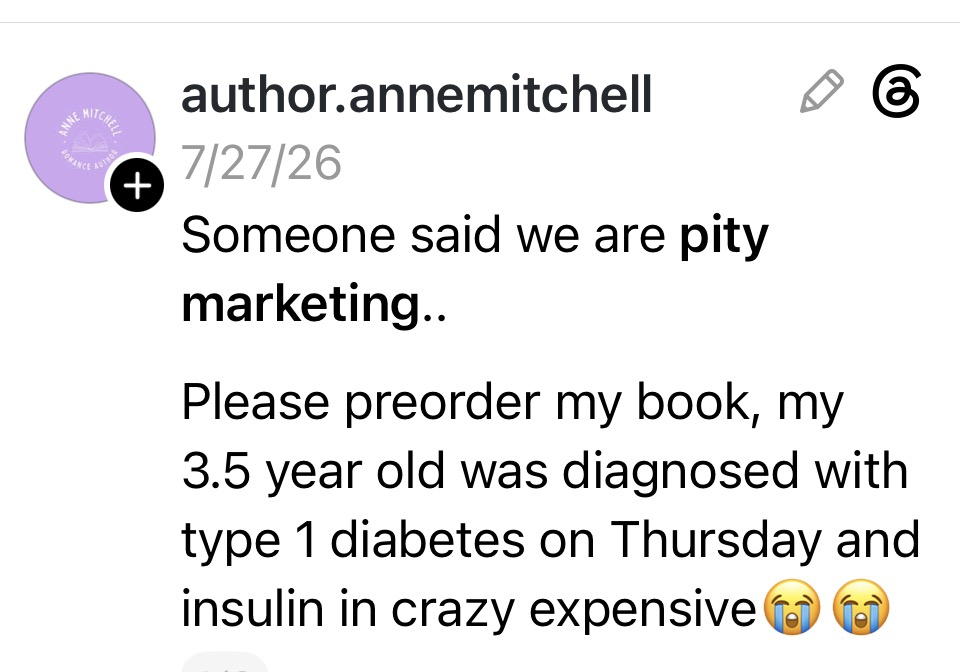
Somehow, it became popular to use one’s book as a fundraiser for a hardship in their life. Another author jumped on the bandwagon by posting, “Ooh are we doing the pity marketing? I can do this. Please buy my book, I got asked for divorce over text last Monday.”
I’m not here to heap criticism on anyone. I applaud these authors for their vulnerability and willingness to be real about the struggles of life and also, releasing their book. As important as it is to have safe spaces to express disappointment and frustration, I’m writing today’s post because as writers, it’s important for us to be aware of where our book promotion strategies may take us. I don’t think that people really want to use pity marketing versus other forms of marketing. It seems to reflect the sentiment, “I’ve tried everything else, so I might as well try this.”
MANIPULATION VERSUS GOOD MARKETING
Let’s be honest, good marketing is hard. There’s rarely an instant reward for all of our hard work. In some ways, pity marketing feels like a shortcut because so many authors feel like the main system is broken. You’re just trying to get your book into people’s hands, for goodness sake! Instead, you’re fighting with stingy, changing algorithms, competition and the pressures of everyday life.
I know that some believe that that all marketing is also manipulation. I don’t agree. There is a difference. Good marketing and pity market stir up the audience”s emotions. However, good marketing motivates an audience to say “yes” to a benefit for themselves. Pity marketing tends to benefit the the person making the offer.
Manipulation is about us getting what we want.
Good marketing is about giving readers what they want.
There’s a big the difference.
As a literary agent, I encourage my clients to think about their writing careers over a long trajectory of years. Not every book proposal will sell, not every book released will sell like hotcakes. The reality is that we can’t control those things. But, what can we control? We have complete agency over how we show up, how we build trust, connection, and add value to our readers. We have control over our consistency and our willingness to keep growing. As an author, we’re the tortoise in Aesop’s Fable. Slow may not be sensational or sexy, but one good quality social media post at a time is our best strategy to finish our author race.
CREATIVE ALTERNATIVES TO PITY MARKETING
If you’ve felt discouraged lately (or if pity marketing seems tempting), I hope this next section offers a refreshing jumpstart to your book marketing. Here are three examples of posts that fall under the pity marketing strategy followed by three productive approaches as alternatives. If you have additional suggestions, I’d love to hear them in the comments.
Pity Marketing Example #1: Pouty photo with Caption: No one came to my book signing. I’m really bummed! Who wants to buy my extra books?
Productive Marketing: My next book signing will be hosted at Sparks Winery on October 8, and YOU’RE INVITED! I’m giving away two signed copies and donating two to your favorite library, PLUS I’m making my signature cocktail and cheesecake!
*
Pity Marketing Example #2: (Threads post) “I’ve worked for years on this book! Why is marketing so hard? Why can’t people just buy my book???!!!
Productive Marketing: (Threads post): Who’s dreaming about writing a book? Let me share 10 things I’ve learned about writing this book. Jump in the comments and tell me which one resonates with you – I’ll pick a winner for a free copy of my book! If you’d like to check it out, click my link in the comments!
*
Pity Marketing Example #3: (Instagram rant) Why won’t the algorithm show my book posts to more people? I feel like I worked way too hard and no one is seeing what I’ve done. Instagram sucks.
Productive Marketing: (Carousel IG Posts) Stop the scroll! These five sentences can dramatically improve your mood! If you loved these, there’s more inspiration in my book. Drop BOOK in the comments and I’ll send you five more inspiring thoughts to make you smile and a link to purchase my book.
In the pity marketing examples, the focus is on the writer, whereas the productive marketing examples exude energy, generosity, encouragement, and positivity. These posts keep the focus on your writing and your hard work. In many ways, how you market your books and yourself shapes a profile in a prospective reader’s mind. Even if they don’t buy right now, people like to follow people who inspire and encourage.
CONCLUSION
As Books & Such agents and staff, we love writers. We write this weekly blog on our website and Substack for the sole purpose of equipping and encouraging writers, whether or not we represent you. We believe that every writer and their story deserves dignity. So, I hope that you will market your books and yourself with hope and pride.
JOIN THE CONVERSATION…What do you think about the pity marketing trend? What types of creative marketing has worked for your lately?
© Barb Roose, Books & Such Literary Management 2026
CHECK OUT OUR MOST RECENT BOOKS & SUCH PODCAST! Click Here to Listen!

 Top Things to Edit Out of Your Writer Self-Talk
My goodness, yes. Love this newsletter! I’ve seen this sort of (pity) marketing and my first thought is always, “You are not writing for the right reason and instead writing from an ignorant and arrogant idea that you are going to become a writer by finishing a book and thinking it will make you rich or something, regardless of the book’s contents. And therefore, no, I do not want to waste my time and money buying or reading your book. Buy-my-book-out-of-pity is a guilt tactic. That’s a kiljoy. No thanks. Mute. Unfollow. Next.
Most of the books I buy are written by authors who barely have time or maybe even have no time for social media, let alone peddling their products. They usually have less social media followers than me (because they are too busy writing for all that), win literary awards, don’t do things like giveaways, do teach writing classes, don’t write for money, and do stay on brick and mortar book shelves for decades.