If you’re on the hunt for something to read, I have recommendations.
In my first blog post in a new year, as has been my tradition for I don’t-know-how-long, I review the best of the best from my reading the year before. Most of these aren’t of-the-minute new releases, but instead books that piqued my interest.
2025 was a boon year. I had a hard time deciding which books to list for you because I had so many great reading experiences. Isn’t that a wonderful thing to be able to say!?
Something to Read in Nonfiction
Two nonfiction books–very different from each other–made my Top Reading List.
First up is Demon of Unrest by Erik Larson. I’ve read numerous books by Erik Larson on fascinating moments in history. His exquisitely-detailed research never fails to surprise, and his ability to describe a person’s appearance, manner of relating to others, and quirks adds rich “flavor.” Demon of Unrest: A Saga of Unrest, Hubris, Heartbreak, and Heroism at the Dawn of the Civil War provides insights even those who are students of the Civil War are unlikely to have unearthed.
Why This Book?
These reviews of Demon of Unrest help to explain why it captivated me.
“Larson, one of today’s per-eminent nonfiction storytellers, trawls a variety of archives to explore the historically momentous months between Abraham Lincoln’s election and the Battle of Fort Sumter.”—The New York Times
“A feast of historical insight and narrative verve . . . Larson’s great gift is his uncanny ability to spin a chronological story whose ending we already know—secession, rebellion, victory, emancipation and assassination—yet keep the narrative as crisp and suspenseful as an Anthony Horowitz suspense novel. . . . This is Erik Larson at his best, enlivening even a thrice-told tale into an irresistible thriller.”—The Wall Street Journal
I would add to these reviewers’ perspective that this is a long saga. I thought it could have been shortened a wee bit. But, on the whole, I was profoundly engaged from beginning to end. His portrayal of Lincoln is particularly touching, as he shows us much about the man I didn’t know.
Art Thief as Art Itself
The Art Thief, also a narrative nonfiction like Demon of Unrest, by Michael Finkel, enthralls the reader (enough to become a New York Times #1 bestseller).
The narrative details include: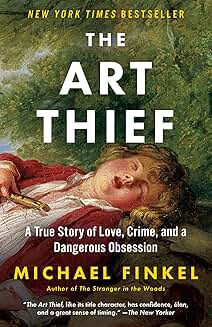
Stéphane Bréitwieser is the most prolific art thief of all time.
He pulled off more than 200 heists in various European countries, often in crowded museums in broad daylight.
His girlfriend served as his accomplice.
His collection was worth an estimated $2 billion.
He never sold a piece, instead displaying his stolen art for his own enjoyment in his attic bedroom.
He felt like a king.
Until everything came to a shocking end.
What’s so Special about It?
“Meticulously detailed, [a] page-turning account….As much a crime caper as a psychological thriller, Finkel’s narrative interweaves gripping descriptions of Breitweiser’s in-plain-sight thefts armed with nothing more than stealth and a Swiss Army knife, a concise history of global art theft, and psychologists’ musings on Breitwieser’s unconscious motivations….Finkel deftly keeps us swaying between great sympathy for his central character and profound suspicion.” —Jenny McPhee, Air Mail
“The Art Thief benefits from a built-in ticking clock as time runs out for Breitwieser and his girlfriend. Finkel controls the pace effortlessly, broadening and narrowing focus from the day-to-day of the thieves to the intricate plotting of their thefts and a history of art crime, as well as who steals and why. That combined with mounting dread for the artworks’ fate makes for a heart-pounding read.”
—Maren Longbella,Star Tribune
Reading this book left me stunned at the audacity, fascinated by the methods, and outraged that priceless pieces were stolen not just from the museums where they were but also from all of us art lovers.
Something to Read in Historical Fiction
I would suggest Clear by Carys Davies. I heard the author being interviewed on NPR about her book, and I found the concept intriguing. And the fact the author had to learn an obscure language from library research only to write the book. After listening to the interview, I rushed out to purchase it.
What’s the Story About?
John, an impoverished Scottish minister, has accepted a job evicting the lone remaining occupant 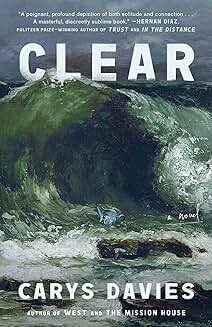 of an island north of Scotland—Ivar, who has been living alone for decades, with only the animals and the sea for company. Shortly after John reaches the island, he falls down a cliff and is found, unconscious and badly injured, by Ivar who takes him home and tends to his wounds. John begins to learn Ivar’s language, and Ivar sees himself reflected through the eyes of another person for the first time in decades.
Will John kill Ivar, as he’s been directed to do if Ivar won’t abandon the island? How will Ivar respond when he discovers his newfound friend has come to remove him from the only life he’s ever known?
Clear unfolds during the final stages of the infamous Scottish Clearances—a period of the 19th century that saw whole communities of the rural poor driven off the land in a relentless program of forced evictions. This singular novel explores what binds us together in the face of insurmountable difference, the way history shapes our deepest convictions, and how the human spirit can endure despite all odds. Moving and unpredictable, “a love letter to the scorching power of language” (The Guardian), Clear is “a jewel of a novel” (The Washington Post)—a profound and unforgettable read.
Clear is a tour de force of the power and beauty of language. Davies’ ability to bend the English language to portray the wild beauty of sea, cloud, wind is a thing of beauty in and of itself.
I do need to mention that I found the resolution to the complex relationships at the close of the book one I didn’t care for.
A Folktale Worth Reading
Once upon a River by Diane Sutterfield is a folktale, a gothic dark read like Jane Eyre, 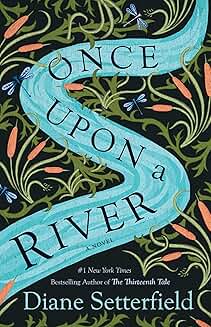 and a masterful use of allegory and vocabulary.
On a dark midwinter’s night in an ancient inn on the river Thames, an extraordinary event takes place. The regulars are telling stories to while away the dark hours as is their custom, when the door bursts open on a grievously wounded stranger. In his arms is the lifeless body of a small child. Hours later, the girl stirs, takes a breath, and returns to life.
Those who dwell on the river bank apply all their ingenuity to solve the puzzle of the girl who died and lived again, yet as the days pass the mystery only deepens.
Three families are keen to claim her. To which does she belong? Since she is mute and emotionally distant, she offers no help in answering the questions.
Sutterfield makes certain the reader never forgets that the river running through the characters’ lives touches each in profound ways–whether through its chilly depths or its flooding rage.
Once upon a River is a glorious tapestry of a book that combines folklore and science, magic and myth. Suspenseful, romantic, and atmospheric, this is “a beguiling tale, full of twists and turns like the river at its heart, and just as rich and intriguing” (M.L. Stedman, #1 New York Times bestselling author of The Light Between Oceans).
If you appreciate fine storytelling by a wordsmith who showcases just how powerful tales can be, then this book is for you.
A Novel that Defies Category
“From the flat roof of the kitchen Patch looked out through serried pin oaks and white pine to the loom of St. Francois Mountains that pressed the small town of Monta Clare into its shade no matter the season. At thirteen he believed entirely that there was gold beyond the Ozark Plateau. That there was a brighter world just waiting for him.
“Though later that morning, when he lay dying in the woodland, he’d take that morning still and purse it till the colors ran because he knew it could not have been so beautiful. That nothing was ever so beautiful in his life.”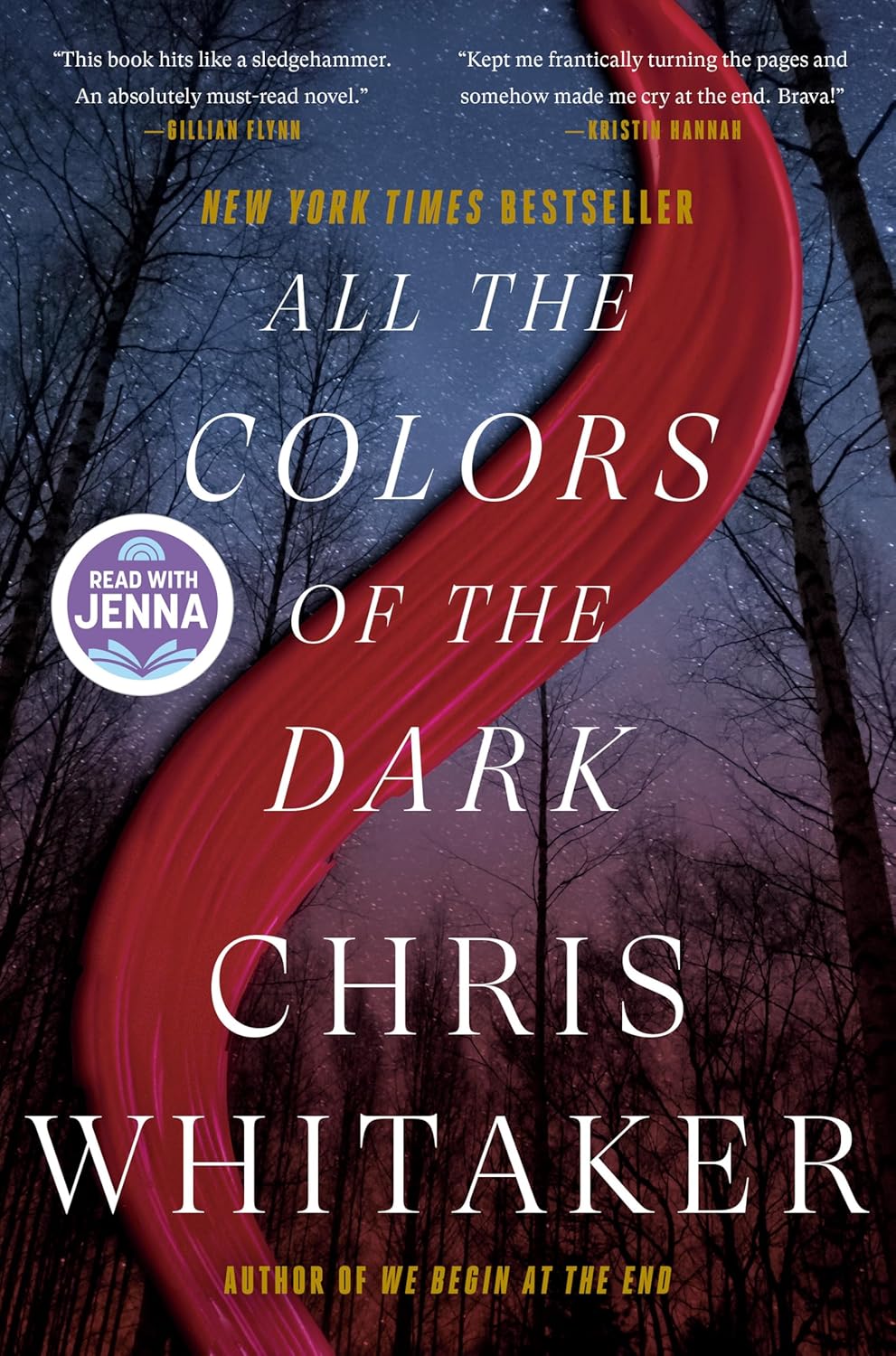
Thus begins All the Colors of the Dark by Chris Whitaker. Patch found himself that morning playing the part of hero, and thus saved a young girl’s life. What it cost him, the girl, and the town form the framework of All the Colors. The ripples never end for all involved.
Why Is It Worth Reading?
All the Colors is a thriller replete with a serial killer run amuck, a boy whose life was formed in the dark of the repercussions of his choice, the girl he loved and loved him, but the dark that kept them separated, and the light Patch could see even in the dark. It’s also a poem, a wry joke, a tender love story, and a paean to sacrificing all you have for those dear to you.
“This is literary fiction that works as a crime thriller. The deadpan humor is pitch-perfect, the plot cinematic.”—Boston Globe
“Melds tense suspense with a powerful exploration of devotion, obsession, and love.”—People
“This book hits like a sledgehammer. Equal parts harrowing and triumphant, Chris Whitaker’s novel is a haunting story of America, alternating between its twin strands of violence and love. An absolutely must-read novel.”—Gillian Flynn
What These Book Are Not
If you’re looking for a beach read, an entertainment, a lighthearted rom-com, none of these will suit you.
If you’re looking for books that challenge your thinking about life, love, the choices we make and where we fit in this world, then you’ll find what you’re looking for. The writing in each is of the highest level. Not to mention a serious kind of entertainment that leaves you satisfied as you reach “the end.”
Enjoy!
What books touched you in a profound way in 2025? Give us something to read.
Bookhead Image by Gerd Altmann from Pixabay

Thanks for the recommendations. I made a note of them. I read All the Colors of the Dark and was blown away by it. Thanks!
So nice to “meet” someone who enjoyed All the Colors of the Dark along with me.
My son gave me Erik Larson’s The Devil in the White City — I’m partway through, very much intrigued by history I never knew about a city where we lived for decade. I look forward to his Civil War story.
Welcome to the Erik Larson fan club, Shirlee.
Wow! I think Colors of the Dark sounds especially interesting. Some of my favorites from 2025 were The Collector of Burned Books by Roseanna M. White, Through Water and Stone by Karen Barnett and I’m Afraid You’ve Got Dragons by Peter S. Beagle. So so good!
That’s a great list of favorites, Kristen, although I confess I’m not familiar with I’m Afraid You’ve Got Dragons. Love that title!
The Art Thief and Clear have been on my radar for a while. I will bump them up my list!
In 2025, I succumbed to more best sellers and reviewers’ recommendations than I usually do and was often disappointed by meandering plots, stilted dialogue, and unnecessary profanity. (I can overlook a lot. But come on, I have to draw a line somewhere. Hello, Catherine Newman and Sandwich. Yes, I’m talking to you.)
My favorites in non-fiction:
The Third Gilmore Girl by Kelly Bishop
It Wasn’t Roaring, It was Weeping by Lisa Jo Baker
Be Ready When the Luck Happens by Ina Garten
Fiction: The Story She Left Behind by Patti Callahan Henry
(special mention to The Words We Lost by Nicole Deese — both are so good!)
The Women by Kristin Hannah
The Love Haters by Katherine Center (probably my current general market favorite author)
Great Big Beautiful Life by Emily Henry
Thank you for these recommendations!
What a great list, Carrie! I confess that I’ve never connected with Kristin Hannah’s books. They always strike me as “meh.” I know: I’m lonely occupying my “not for me corner” on that one. I’ve been wanting to try Emily Henry. Seeing her on your list encourages me. And Ina Garten wrote a trade nonfiction book!? I love that title!
The Ina Garten and Emily Henry books are excellent!